
Game Production & Team Lead
Producing interactive training experiences across multiple industries, coordinating multidisciplinary teams from initial client requirements through development and delivery. My role combines production planning, stakeholder communication, scope management and task coordination
01 — My Role
Game Producer & Team Lead
I manage simulation projects from initial client conversations through planning, development, review, and delivery. I translate stakeholder requirements into actionable production plans, coordinate the multidisciplinary team, manage priorities and capacity, and maintain communication between the client and development team throughout production.
02 — From Client Brief to Delivery
01
CLIENT GOAL
Understand the objective
02
REQUIREMENTS
Translate stakeholder needs
03
SCOPE & BREAKDOWN
Turn requirements into executable work
04
PRODUCTION & PLAN
Prioritize against capacity
05
DEVELOPMENT
Track & adapt execution
06
REVIEW & DELIVERY
Validate, iterate and deliver
03 — Producer Sheet / Tailored Planning Sheet
The Problem
Changing priorities made delivery planning difficult
I introduced the Producer Sheet in response to recurring delivery delays and shifting priorities. As new requests entered development, existing deadlines often remained unchanged, making it difficult to maintain a realistic view of delivery. I created a structured production workflow that breaks requirements into concrete deliverables and tasks, maps dependencies, assigns ownership, and establishes priorities. This created a shared roadmap between stakeholder expectations and day-to-day development, while making the impact of scope and priority changes visible.

Producer sheet - overview
04 — Production Toolkit
⚒Tools
Planning & Tracking
Documentation
Communication
Team Operations
Planning & Tracking
I use weekly planning cycles to translate current project priorities into clear, achievable work for the team. I maintain the production backlog, review dependencies and capacity, and adjust priorities when new requirements or blockers affect the existing plan.
Documentation
I maintain structured documentation for requirements, project decisions, workflows and delivery handoffs. I also create reusable templates for recurring production needs, reducing setup time while keeping information consistent and accessible across projects.
Communication
I act as a communication bridge between stakeholders and the development team. Client discussions are translated into clear requirements and priorities, while progress, constraints and development implications are communicated back to stakeholders throughout production.
Team Operations
I coordinate team capacity alongside production priorities, taking workload, dependencies and availability into account when planning development. This also includes supervising interns, supporting team members when blockers arise, and planning around leave to maintain continuity across projects.
05 — Managing the Team
COORDINATING PEOPLE, PRIORITIES & DEPENDENCIES
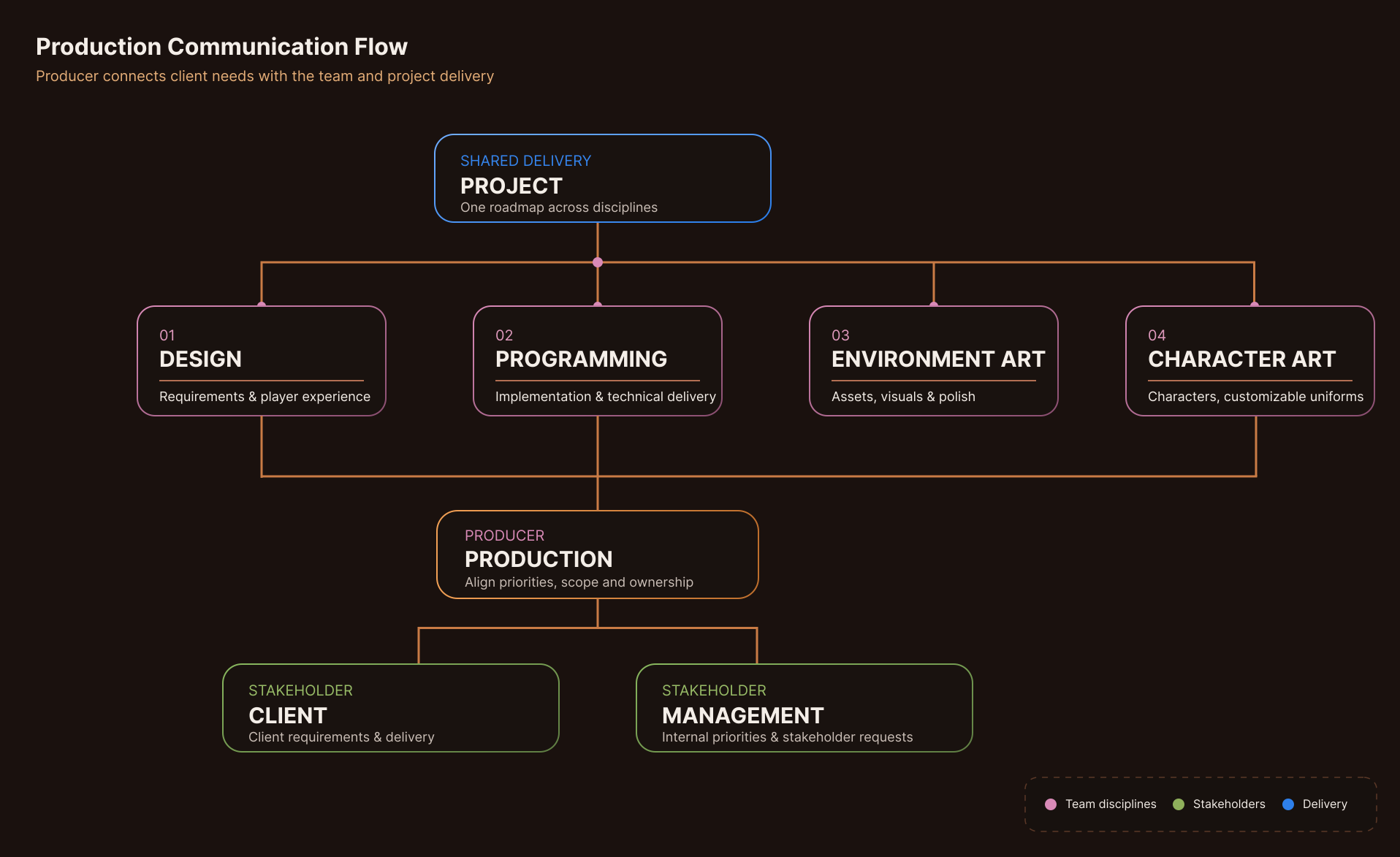
I coordinate day-to-day production across design, programming, environment art and character art, keeping workloads, dependencies and team availability visible when planning priorities. When blockers or changing requirements affect the plan, I work with the team to reorganize priorities and keep development moving without losing sight of delivery goals.
Production Communication Flow
- 01
Capacity & Coordination
I plan work around team capacity, dependencies and availability, adjusting priorities when workloads or project requirements change.
- 02
Team Support
I maintain visibility on blockers and dependencies, helping developers and artists identify what they need from one another and reorganizing work when necessary.
- 03
Mentorship & Continuity
Alongside coordinating the core team, I have supervised two interns and plan around team leave and availability to maintain continuity across active projects.
06 — Project Example
Production in Practice
Assistant Mechanic Training Simulation - Confidential Client
Production in practice
01
CLIENT NEED
Deliver a systems and mechanics training simulation grounded in real vocational practice within a fixed three- month window. Training expert input helped identify priority tasks.
02
MY PRODUCTION APPROACH
Translated training expert and stakeholder input into requirements and trackable tasks, mapped dependencies, assigned ownership, monitored progress through weekly check-ins.
03
THE CHALLENGE
The initial scope exceeded the available timeline, creating ongoing pressure to balance scope, capacity and delivery priorities
04
MY RESPONSE
Prioritized core systems, restructured lower priority work, and used biweekly client demos to make scope versus time trade-offs clear.
05
DELIVERY
Delivered the Assistant Mechanic training simulation with the prioritised core systems, supported by handover documentation covering functionality, controls, requirements and benchmarks.
07 — Results
sectors delivered
Healthcare, Hospitality, ICT, Technical and Construction.
Cross-discipline Coordination
- ●Design
- ●Programming
- ●Environment Art
- ●Character Art
Adaptive Production
I adapt planning structures, workflows, and team processes as project needs evolve, keeping priorities and responsibilities clear without forcing every project into the same mold.
Good production creates clarity. Every project introduces new constraints and dependencies. My role is to help teams see what matters now, what comes next, and how changes affect delivery.